







Product classification
Contact Us
E-mail
hm@heatmatetech.com
Service Hotline:
400-812-2880

59℃ Phase-Change Thermal Battery
Key words:
Phase Change Thermal Storage
Heat Battery Storage Manufacturers
Classification:
Product Details
59℃ PHASE-CHANGE THERMAL BATTERY
Based on own intellectual property rights of high energy storage density and stable phase-change materials, HeatMate has developed high efficiency phase-change thermal battery, which can collect and store low-cost, intermitent and unstable energy such as valley electricity, solar energy, industrial waste heat, etc., and then release them in a controllable way, which are widely used in the fields of clean heating, hot-water supply, grids peak regulation, and photovoltaic and photothermal energy utilization.
PARAMETERS
| Model | HM-059H650 | HM-059H500 |
| Dimension(mm) | 1180(L)x940(W)x1985(H) | 940(L)x940(W)x1985(H) |
| Weight (kg) | 2300 | 1800 |
| Phase Change Temperature (℃) | 59 | 59 |
| Rated Heat Storage Capacity (MJ/kWh) | 650/180 | 500/140 |
| Charging Temperature (℃) | 80~85 | 80~85 |
| Discharging Temperature (℃) | 40~55 | 40~55 |
| Charging/Discharging Power (kW) | 18~45 | 10~33 |
| Tube Side Design Pressure (MPa) | 1.0 | 1.0 |
| Rated Operating Condition Pressure Drop (kPa) | 100(36L/min) | 100(40L/min) |
| Connection Pipe Diameter | DN32(G1 1/4") | DN32(G1 1/4") |
| Heating Area per Unit (㎡) | 400~800 | 300~600 |
PRODUCT FEATURES
High Heat Storage Density
Heat storage capacity is 5 to 8 times that of water
Low Operating Costs
Operational costs reduced by 30% to 70%, low-carbon or zero-carbon heating.
Long Service Life
Equipment life exceeds 20 years.
Green, Safe, and Environmentally Friendly
Operates at atmospheric pressure, no harmful emissions, non-flammable, recyclable.
Easy Installation
Modular design, flexible configuration, standard interfaces, easy maintenance.
High Charge and Discharge Efficiency
Efficiency > 95%, less than 5% heat loss after 24h
Heat storage/heating systems
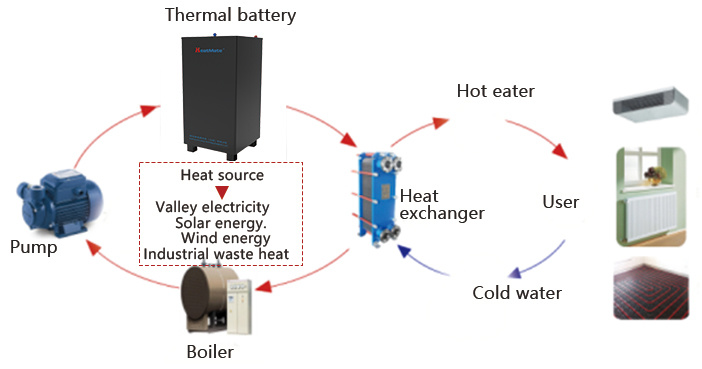
01 Phase-Change Thermal Battery
Phase-change thermal battery are modularly installed toform thermal storage systems.
02 Heat Source Equipment
Electric boilers, solar collectors, waste heat boilers, high.temperature heat pumps, etc.;
03 Circulation Pumps
Circulation pumps circulate working medium (water oranti-freeze)to transfer heat from the heat sourceequipment to the thermal battery or the user end.
04 Heat Exchangers
Heat exchangers are often plate heat exchangers or volu-metric heat exchangers,which transfer heat from theprimary network to the secondary network.
05 Intelligent Control System
Intelligent control system realizes the switching of thesystem's charging and discharging modes and providesheat through the pipeline electric valve.
OPERATION MODE
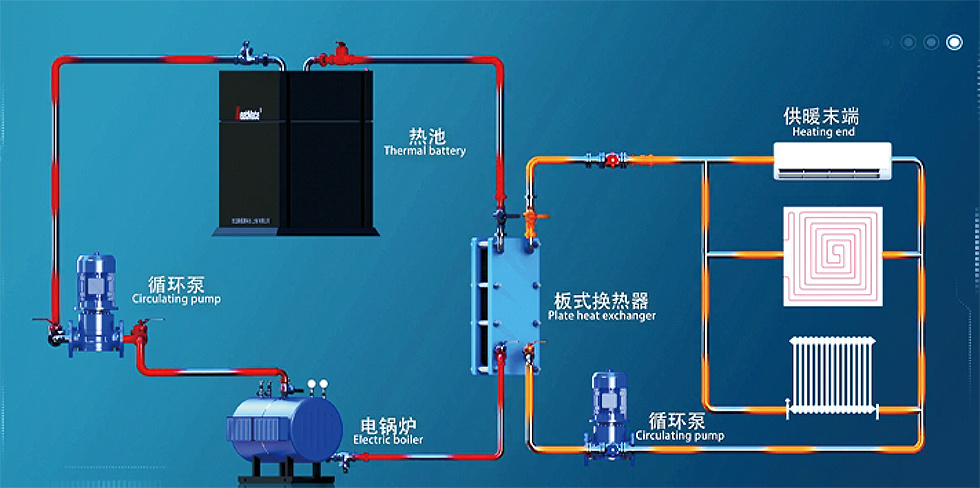
Heat Charging
Heat is stored in the phase-change thermal battery by utilizing cheap energy such as off-peak electricity, solar energy, and waste heat.
Heat Release
Release the heat stored in the thermal battery; reduce the use of high-priced energy, reduce operating costs, and realize low-carbon or zero-carbon heating.
Application Scenarios
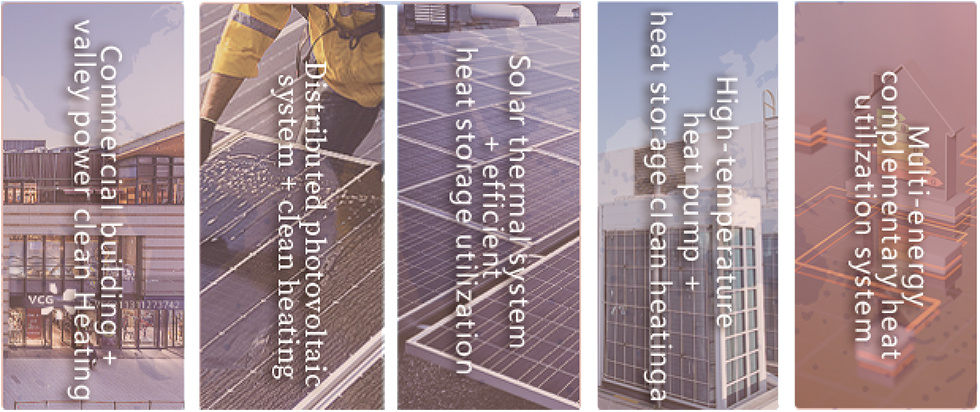
01 Commercial building + valley power clean Heating
02 Distributed photovoltaic system + clean heating
03 Solar thermal system + efficient heat storage utilization
04 High-temperature heat pump + heat storage clean heating
05 Multi-energy complementary heat utilization system
In the area of clean heating, phase change thermal storage plays a crucial role. During peak heating demand, this stored heat can be released, reducing the reliance on traditional heating methods that may be less clean or more expensive. This not only helps achieve cleaner heating solutions but also optimizes energy consumption.
Advanced Heat Battery Storage represents a transformative solution for modern energy systems seeking higher efficiency, better stability, and more sustainable operation. As renewable energy sources continue expanding, industries, commercial facilities, and residential users face the challenge of managing intermittency and storing excess thermal energy effectively. This technology captures, stores, and releases heat with remarkable efficiency, allowing users to balance peak demands, reduce wastage, and optimize overall energy usage. With its intelligent design, long service life, and adaptable integration, advanced heat battery storage has become a key component in next-generation energy management strategies.
At its core, an advanced heat battery uses high-capacity thermal materials that absorb large amounts of heat energy, store it safely, and release it on demand. Compared with traditional boilers or direct heating systems, this solution ensures consistent thermal output without relying on continuous fuel consumption. Automated controls monitor temperature, flow, and energy levels to deliver stable performance across a wide range of applications. Whether paired with solar thermal systems, industrial waste heat recovery, or district heating networks, the heat battery maximizes efficiency by capturing energy that would otherwise go unused. Its modular configuration also allows scalability, enabling users to expand storage capacity as operational needs grow.
One of the major advantages of advanced heat battery storage is its ability to solve long-standing energy management pain points. Traditional heating systems often struggle with fluctuating demand, leading to spikes in fuel usage, overheating, or energy loss. Industrial processes may generate significant waste heat that dissipates into the environment instead of contributing to productivity. Advanced heat batteries address these issues by storing surplus heat for later use, ensuring steady output even during peak demand. This not only reduces operational costs but also significantly lowers carbon emissions. Users gain improved efficiency, better system stability, and enhanced control over their heating cycles.
The system also stands out for its high durability and low maintenance requirements. With no combustion process and minimal mechanical wear, heat battery technology offers long operational life and reliable performance. Its sealed design enhances safety by preventing leakages, oxidation, or contamination. Thermal materials maintain their efficiency over thousands of cycles, allowing the system to function consistently year after year. For facilities aiming to reduce downtime and avoid frequent repairs, this technology delivers dependable heat storage with minimal intervention.
In practical applications, advanced heat battery storage has been successfully deployed in a wide range of environments. Industrial plants use it to recover waste heat from furnaces, compressors, or manufacturing equipment, turning lost energy into valuable heating resources for later use. Commercial buildings integrate heat batteries into their HVAC systems to reduce power demand during peak hours and maintain comfortable indoor temperatures with lower energy costs. Residential communities equipped with renewable heating technologies use heat battery storage to stabilize energy supply, especially during cloudy days or nighttime. In district heating networks, heat batteries help smooth thermal distribution and support energy-sharing models across multiple buildings.
The benefits extend beyond immediate performance improvements. By reducing reliance on fossil-fuel-based heating systems, advanced heat battery storage supports broader sustainability goals and aligns with future energy regulations. It enables businesses to meet efficiency targets, achieve greener certifications, and enhance environmental responsibility. At the same time, improved energy stability and reduced peak loads help lower infrastructure strain, leading to smoother operations and long-term cost reductions.
Advanced Heat Battery Storage is more than a heating device—it is a strategic investment in the future of clean energy and efficient thermal management. Its combination of high efficiency, versatile integration, long-term durability, and environmental benefits makes it an ideal choice for organizations seeking to modernize their heating systems. By capturing more energy, using it smarter, and reducing operational pressures, this technology empowers users to build a more resilient, sustainable, and cost-effective thermal infrastructure for years to come.
The 59℃ Phase-Change Thermal Battery (PCTB) represents a significant advancement in thermal energy storage technology, addressing the growing demand for efficient, sustainable, and compact energy solutions in a variety of industrial, commercial, and residential applications. Phase-change materials (PCMs) have been widely recognized for their ability to store and release thermal energy at a nearly constant temperature, and the 59℃ PCTB specifically leverages a PCM with a phase-change point around 59℃ to deliver reliable thermal management in diverse scenarios.
At the core of the 59℃ PCTB is a specially engineered phase-change material designed to undergo a solid-liquid transition at approximately 59℃. During this transition, the material absorbs large amounts of latent heat without a significant change in temperature, effectively acting as a thermal “battery.” This property allows the storage of excess thermal energy during periods of low demand and its subsequent release during high-demand periods. Such a mechanism offers superior energy efficiency compared to conventional sensible heat storage, where temperature variations are required to store and release energy.
One of the primary advantages of the 59℃ PCTB is its operational temperature range. The 59℃ transition point is ideal for numerous applications, particularly in heating, ventilation, and air conditioning (HVAC) systems, domestic hot water preheating, and low-temperature industrial processes. In HVAC systems, for instance, the PCTB can store heat generated during off-peak hours, such as from solar thermal panels, and release it when heating is needed, reducing reliance on electricity or fossil fuels. Similarly, in industrial processes that require stable low-temperature heat, the battery provides a compact and reliable energy source that mitigates energy waste and reduces operational costs.
The design of the 59℃ PCTB focuses not only on thermal performance but also on durability, safety, and environmental friendliness. The PCM is encapsulated in corrosion-resistant containers that prevent leakage and degradation over multiple phase-change cycles. This encapsulation ensures that the material retains its thermal storage capacity over thousands of heating and cooling cycles, making the battery a long-lasting solution for energy storage. Furthermore, many modern 59℃ PCTBs employ non-toxic, bio-based PCMs, reducing environmental impact and addressing sustainability concerns associated with traditional chemical-based thermal storage materials.
Efficiency is a critical aspect of any thermal energy storage system, and the 59℃ PCTB excels in this regard. By utilizing latent heat storage, the system can store large amounts of thermal energy in a relatively small volume. This compactness is particularly advantageous in urban environments where space is limited or in mobile applications where transportability is required. The battery’s thermal conductivity is optimized through the incorporation of high-conductivity materials or fin structures, ensuring rapid charging and discharging of thermal energy with minimal losses.
From an energy management perspective, integrating the 59℃ PCTB into existing infrastructure can yield significant economic and environmental benefits. By shifting energy consumption from peak to off-peak hours, businesses and households can reduce electricity costs and alleviate strain on the grid. Additionally, coupling the PCTB with renewable energy sources, such as solar or geothermal systems, enables the efficient storage of intermittent energy, making renewable power more reliable and consistent. In regions with high heating demand, the battery’s ability to maintain a stable thermal output can reduce reliance on fossil fuel-based heating systems, contributing to lower carbon emissions and supporting global sustainability goals.
The versatility of the 59℃ Phase-Change Thermal Battery extends beyond stationary applications. Mobile and modular PCTB units are increasingly being developed for transportation, cold chain logistics, and emergency heating solutions. For example, mobile thermal storage containers equipped with 59℃ PCTBs can provide temporary heating for disaster relief shelters or remote construction sites, where conventional heating infrastructure may be unavailable. In the cold chain industry, the PCTB can be adapted for preheating or maintaining specific temperature ranges in conjunction with refrigerated transport, improving the efficiency and reliability of perishable goods delivery.
Recent innovations in material science have further enhanced the performance of the 59℃ PCTB. Advances in microencapsulation, composite materials, and thermal interface design have improved heat transfer rates, minimized supercooling effects, and increased overall energy density. These improvements enable faster response times, better thermal uniformity, and higher reliability, broadening the battery’s applicability in both residential and industrial sectors. Moreover, ongoing research into hybrid systems, combining PCMs with other thermal storage technologies, promises to further elevate the efficiency and adaptability of the 59℃ PCTB in complex energy networks.
Safety is a critical consideration in the design and deployment of thermal batteries. The 59℃ PCTB operates at a moderate temperature range, reducing the risk of burns or fire hazards compared to high-temperature thermal storage systems. The encapsulated PCM is chemically stable, non-flammable, and resistant to thermal degradation, ensuring safe operation in a variety of environments. Additionally, the system’s modular design allows for easy monitoring and maintenance, minimizing operational risks and prolonging service life.
The economic potential of the 59℃ Phase-Change Thermal Battery is substantial. By reducing energy waste, lowering peak energy demand, and integrating with renewable energy sources, the PCTB can contribute to significant cost savings over its operational lifespan. Governments and industries are increasingly recognizing the value of such thermal energy storage solutions in achieving energy efficiency targets, reducing greenhouse gas emissions, and promoting sustainable development. Incentives and subsidies for energy storage technologies further enhance the financial attractiveness of deploying 59℃ PCTBs in commercial and residential projects.
Looking forward, the future of the 59℃ Phase-Change Thermal Battery is closely tied to the broader trends in energy efficiency, renewable energy adoption, and smart energy management. As smart grids, Internet of Things (IoT)-enabled energy systems, and demand-response strategies become more prevalent, PCTBs will play an essential role in balancing supply and demand, improving grid stability, and optimizing energy utilization. Their compact form factor, high energy density, and environmentally friendly design make them ideal candidates for integration into next-generation energy networks.
In conclusion, the 59℃ Phase-Change Thermal Battery exemplifies the potential of phase-change materials to transform thermal energy storage. Its moderate operating temperature, high energy density, long cycle life, and environmental compatibility make it a versatile solution for residential, commercial, and industrial applications. By enabling efficient heat storage and release, the 59℃ PCTB reduces energy consumption, supports renewable energy integration, and contributes to sustainable energy solutions worldwide. As material science and engineering continue to advance, the 59℃ PCTB is poised to become a cornerstone of modern thermal management and energy storage strategies, offering a reliable, safe, and efficient way to harness thermal energy for a wide range of applications
Previous Page:
Product inquiry
* Please leave your phone number and we will contact you within 24 hours!


Service Hotline:

Shanghai (Headquarters)
398 Songying Road, Qingpu District, Shanghai


Online message
Links: Sunman New Energy | CATL | State Grid | HeatMate New Energy Technology (Hong Kong) Co., Ltd.